Technology
has changed everything, and our brains are no different (Keegan, 2012).
Technology has literally changed the way our brains function, which has caused
a huge cultural shift (Keegan, 2012). That shift is to a world where people can
have entire relationships online and never actually meet their partner in
person, face-to-face. This is a positive thing in the fact that it allows
so many people to create new connections with others that they never would have
been able to before technology (Petric, Petrovcic, & Vehovar, 2011). However, it does also create one major negative result
(Petric et al., 2011).
People feel
less pressure and feel that they are able to connect easier when there is
computer-mediated technology involved (Petric et al., 2011). Those are new
skills that have been created because of new technology. Gaining those news
skills is not only a good thing, but has become necessary to be able to survive
in the technological age (Petric et al., 2011). The problem that is surfacing,
though, is that people are not maintaining the old skills necessary to
communicate with others when there is not a computer screen between them
(Keegan, 2012; Turkle, 2012). Furthering that, the youth of today is even
beginning to no longer learn the interpersonal skills that are required in
face-to-face interactions (Turkle, 2012).
It is vital
for people to gain the new communication skills necessary to remain as a
valuable source both professionally and personally (Kolodzy, 2013). However
that does not mean that the skills required for communication outside of the
technological world are no longer relevant and needed (Turkle, 2012). Those
skills seem to be forgotten. Society is in the process of raising a
generation of people who will be able to communicate with anyone in the world
when they have a keyboard in front of them, but no one when they are facing
someone in person (Turkle, 2012). This situation becomes even worse when
research has shown that people actually have more positive impressions of
others when the communication is face-to-face as opposed to computer-mediated
(Okdie et al., 2011). Society is going to raise a generation of people who are
connected around the world, but in that same sense are completely alone
(Turkle, 2012).
So how does
society go about solving this dilemma? There is an easy solution to this
problem. Society cannot let the communication skills that do not require
technology to be left behind. They have to teach the younger generations to put
their computers down and learn to communicate face-to-face with others or those
skills will be lost (Turkle, 2012). The difficult part of this solution is
finding a balance. Though society still needs to have the older communication
skills, the new ones created because of technology cannot be forgotten either
(Turkle, 2012). Society cannot progress if it does not hold on to some skills
from the past (Kolodzy, 2013; Turkle, 2012) However, it also cannot progress if it does not gain some skills for
the future (Kolodzy, 2013). It is important for new skill sets to be gained, but
at the same time, completely losing the old ones cannot be an option (Keegan, 2012; Turkle, 2012).
References:
Keegan, S. (2012). Digital technologies are re-shaping our
brains. Qualitative Market Research, 15(3), 328-346.
Kolodzy,
J. (2013). Practicing convergence
journalism. New York, NY: Routledge Taylor & Francis Group.
Okdie, B. M., Guadagno, R. E., Bernier, F. J., Geers, A. L.,
& Mclarney-Vesotski, A. R. (2011). Getting to know you: Face-to-face versus
online interactions. Computers in Human
Behavior, 27(1), 153-159.
Petric,
G., Petrovcic, A., & Vehovar, V. (2011). Social uses of interpersonal
communication technologies in a complex media environment. European Journal of Communication, 26(2), 116-132.
Turkle,
S. (2012, March). “Connected, but alone?.” Ted Talks. Lecture conducted
from Long Beach, California.
This video is a Ted
Talk presented by Sherry Turkle. She explores the concept that people are
living in a world that is more connected than ever before, but yet they are
really alone. She explains that because people are becoming more and more tied
to their computers, they are becoming less and less tied to other people,
outside of their computers. She even presents the idea that people may be
losing the communication skills necessary to interact with others in person. This is because the young are only learning to interact with others when there is a
computer in front of them.
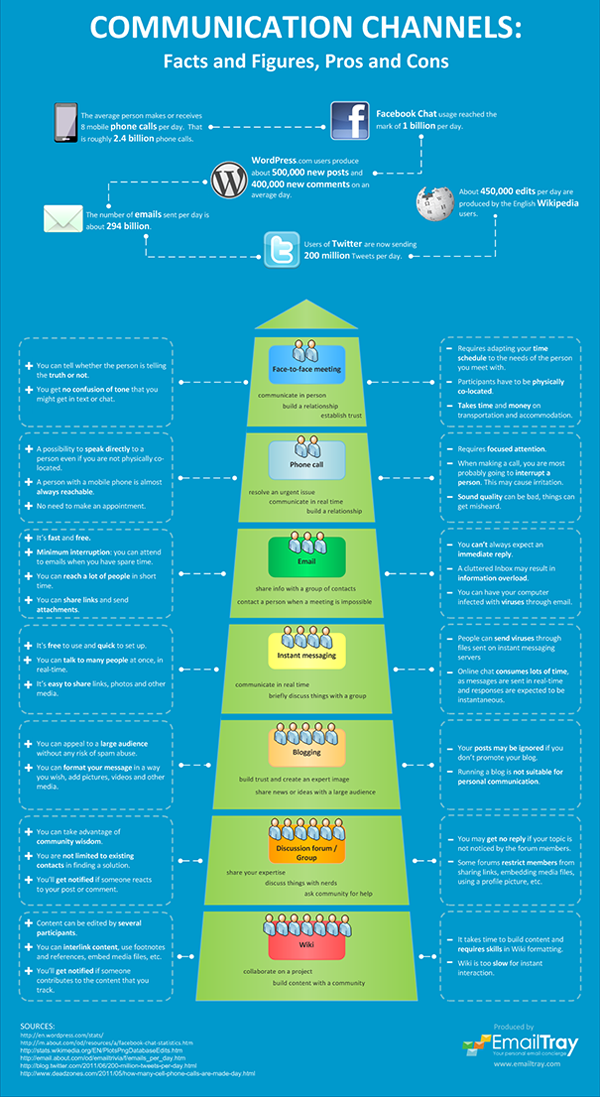
This infograph shows the communication channels that people
now use. It shows multiple channels and includes the positives
and negatives of each channel.
This video explains five ways that social media is changing people’s brains. Since this blog focuses on how social media is changing people’s brains and interactions, this video helps to further explain that concept.
References:
AsapScience.
(2014). 5 Crazy Ways Social Media is
Changing Your Brain Right Now [YouTube Video]. United States.
Pimanova, J.
(2012). Communication channels infographic: Facts and figures, pros and cons. EmailTray. Retrieved from http://www.emailtray.com/blog/communication-channels-infographic-facts-and-figures-pros-and-cons/
Turkle,
S. (2012, March). “Connected, but alone?.” Ted Talks. Lecture conducted
from Long Beach, California.

No comments:
Post a Comment