Wednesday, October 15, 2014

Privacy?


            With the advent of new technology that allows people to give out so much of their information, it brings up the idea of privacy. Society’s expectation of privacy has changed because of new technology (Cakrani, 2013; Zuo & Jiang, 2013). New technology such as social media has allowed people to post their private information in a public web location. In fact, it has even created a culture where it is normal for private information to be posted on websites such as Twitter and Facebook (Cakrani, 2013). Before these types of websites were created, it would not have been a normal thing for people to give out their current location, job information, or personal information on the Internet. However, social media has created a society that holds the attitude that it is not only acceptable to put that information on the Internet, but it is almost essential to do so (Cakrani, 2013; Packard, 2013).
            There is an issue with this lack of interest in security and privacy, though. That issue is that privacy is becoming harder for people to obtain and maintain (Cakrani, 2013). With new technology comes new ways for others to get people’s private information which, many times, has negative results (Cakrani, 2013; Zuo & Jiang, 2013). The problem and cultural shift that has happened is the fact that people feel that is safer to release their information (Cakrani, 2013; Zuo & Jiang, 2013). Users of social media and other websites and technology like it, are lulled into the sense that what they are posting about themselves will be kept private. Unfortunately that is not always the case. An example outside of social media is cell phones. They allow people to access all of their private information on the go. Since it is people’s personal cell phones, they feel secure using it. However, others are able to hack into phones and get that private information (Zuo & Jiang, 2013).
            So how does society go about remedying this? There are two specific things that can be done. First, people need to realize how vulnerable they are making themselves when they post their private information on the Internet (Cakrani, 2013; Packard, 2013; Zuo & Jiang, 2013). Despite what a website or piece of technology may make people think, it is not as secure as they may feel. There needs to be a cultural shift in the opposite direction of what has occurred, which is to have people post less private information (Zuo & Jiang, 2013). Secondly, there is a flip side to the fact that new technology is causing privacy concerns. That is that there has also been technology that has been created as new ways to protect private information (Cakrani, 2013; Zuo & Jiang, 2013). Those types of technology have been created as a way to compensate for the easier ability of people to gain other’s private information. People need to be aware of those options to protect their privacy and actually be willing to use them (Cakrani, 2013; Zuo & Jiang, 2013).


References:

Cakrani, E. (2013). Technology and privacy, internet effects on privacy. Mediterranean Journal of Social Sciences, 4(9), 279-283.
Packard, A. (2013). Digital media law (2nd edition). West Sussex, UK: Wiley-Blackwell.
Zuo, Y., & Jiang, X. (2013). Internet privacy. Studies in Sociology of Science, 4(4), 32-35.


This video is a Ted Talk given by Eli Pariser titled “Beware Online ‘Filter Bubbles.’” In the video, Pariser discusses the filter bubbles that the Internet has created. People receive information from websites such as Google and Facebook based on personal information about themselves such as the computer they are using and where they are located. The reason that this involves privacy issues with the Internet is that this information about people is gathered without the people really being informed.


This infograph shows the new privacy risks that have been associated with new technology. The information shown is a result of surveys conducted. This means that this infograph exemplifies the concern that people are now having about their privacy because of new technology.


The infograph below shows how technology has changed how people do work. It explores the idea of how work was done in the past versus how work is completed now. It then shows evidence of how technology is also changing the kind of privacy society needs to protect themselves. Unfortunately, I cannot make this infograph any bigger than it is, so I have included the link here: http://www.privacyawarenessweek.org/resources.html


References:


APPA. (2014). Technology is changing… so are the privacy risks. Privacy Awareness Week. Retrieved from http://www.privacyawarenessweek.org/resources.html

Pariser, E. (2011). Beware online “filter bubbles.” Ted Talks. Lectured conducted from Long Beach, California. Retrieved from https://www.ted.com/talks/eli_pariser_beware_online_filter_bubbles


Travelers (2013). Technology poses emerging risks. Travelers.com. Retrieved from https://www.travelers.com/prepare-prevent/home/personal-privacy-risks.aspx

Urgency – Are People Missing Something?


            In the past, this blog has discussed how news information needed to be incorporated in social media to be able to get an audience (Kolodzy, 2013). While that is true, it has caused some issues as a result. Since social media requires immediate attention, it has forced news companies to constantly be in a rush to be the first to post news information (Kolodzy, 2013; Tandoc, 2014). This has created a cultural shift to a world of urgency.
            People want information immediately (Kolodzy, 2013). They do not want a lag time between an event happening and hearing about the event that happened (Kolodzy, 2013; Malesardi, 2012). Social media has allowed this to occur. Social media has allowed news companies to post news information the minute that it happens (Kolodzy, 2013). However, there is a question of the accuracy in what is being posted (Malesardi, 2012). It is impossible for news stations to report on something the minute that it occurs without there being a possibly for mistakes (Tandoc, 2014). With events, there are emotions running high, sometimes something looks to be happening that is not, and oftentimes people want to already have an answer for why something is occurring (Tandoc, 2014). All of these facts actually take hours to work out for accuracy. However, now the audience demands that information immediately. News companies are complying with that demand (Kolodzy, 2013). However, as a result, there are mistakes in news reporting (Kolodzy, 2013; Malesardi, 2012; Tandoc, 2014).
            Urgency does not only mean the urgency to get information out, though it does include that. For news companies to be able to maintain the small audiences that they have, there is an urgency to keep them (Malesardi, 2012; Tandoc, 2014). This means that those companies are much more willing to adapt to what their audience wants, as a result (Tandoc, 2014). That very concept perpetuates the problem of urgency in the news even further. Because news audiences want information through social media and want it the minute that it happens, news companies are trying to provide that (Tandoc, 2014). In doing so, mistakes can happen which circles back to how this cultural shift to urgency is actually causing issues (Kolodzy, 2013; Tandoc, 2014).
            This was seen in the news reporting of the Boston Marathon. There were bombs exploding at the Boston Marathon, and each media outlet was fighting to be the first to post information about it. However “in the rush to uncover new information, the media got it wrong… repeatedly” (Siddiqui, 2013). “Whether the coverage was on television, in print or online, facts were misreported, suspects were misidentified, and presumptions were made about unknown motives” (Siddiqui, 2013). These mistakes in reporting were a direct result of the media trying to rush to be the first to post this type of information. This problem becomes even worse when one media outlet posts wrong information that other media outlets grab on to and repost (Tandoc, 2014). All of this need for urgency both created by the media outlets and the audience is causing false information to spread about events (Malesardi, 2012; Tandoc, 2014).
            So how does society go about changing this? This is a particularly difficult thing to change because the Internet and social media have created a world of instant gratification, so people want that same thing when it comes to the news (Kolodzy, 2014). The problem is that it is not realistic for the news to be reported with 100% accuracy the minute that it is occurring. As a result there are two options for people. The audience needs to start understanding that they may not be getting 100% accuracy in the news stories that they are hearing (Kolodzy, 2014). Or, the other option is for the audience to be willing to accept a slower turnaround time for news information (Kolodzy, 2013). The urgency and the mistakes resulting from that are becoming more and more apparent, so those options are all people have to work with at this point.


References:

Kolodzy, J. (2013). Practicing convergence journalism. New York, NY: Routledge Taylor & Francis Group.
Malesardi, M. (2012). Advances in reporting. The Journal of Government Financial Management, 61(4), 4.
Siddiqui, S. (2013). Boston bombings reveal media full of mistakes, false reports. The Huffington Post. Retrieved from http://www.huffingtonpost.com/2013/04/22/boston-bombings-media-mistakes_n_3135105.html
Tandoc, E. C. Jr. (2014). Journalism is twerking? How web analytics is changing the process of gatekeeping. New Media & Society, 16(4), 559-575.    


This infograph shows how social media is influencing news reporting. This is so important because it is the fact that social media is influencing news reporting that started the urgency in that reporting.


This infograph shows the impact of social media on the news and how people get news information. This relates to social media allowing news to be reported the minute that it is occurring.


This infograph supports the information in this blog because it shows the fact that now everyone has the ability to post news information. This also explains the fact that there can be misinformation posted because of social media and new technology.


References:

ING. (2014). Impact of social media on news. Social Embassy. Retrieved from http://www.slideshare.net/ING/infographic-impact-of-social-media-on-news-sming14-36054221

Marino, K. (2012). That’s old news! How social media is replacing traditional journalism as a news source. Schools.com. Retrieved from http://www.schools.com/visuals/social-media-news.html

University of Florida. (2014). Evolution of news media and social media. Digital Media Café. Retrieved from http://jbertho.com/2014/02/24/social-media-is-quickly-becoming-a-major-source-for-news-infographic/


Can Society Still Communicate?


            Technology has changed everything, and our brains are no different (Keegan, 2012). Technology has literally changed the way our brains function, which has caused a huge cultural shift (Keegan, 2012). That shift is to a world where people can have entire relationships online and never actually meet their partner in person, face-to-face. This is a positive thing in the fact that it allows so many people to create new connections with others that they never would have been able to before technology (Petric, Petrovcic, & Vehovar, 2011). However, it does also create one major negative result (Petric et al., 2011).
            People feel less pressure and feel that they are able to connect easier when there is computer-mediated technology involved (Petric et al., 2011). Those are new skills that have been created because of new technology. Gaining those news skills is not only a good thing, but has become necessary to be able to survive in the technological age (Petric et al., 2011). The problem that is surfacing, though, is that people are not maintaining the old skills necessary to communicate with others when there is not a computer screen between them (Keegan, 2012; Turkle, 2012). Furthering that, the youth of today is even beginning to no longer learn the interpersonal skills that are required in face-to-face interactions (Turkle, 2012).
            It is vital for people to gain the new communication skills necessary to remain as a valuable source both professionally and personally (Kolodzy, 2013). However that does not mean that the skills required for communication outside of the technological world are no longer relevant and needed (Turkle, 2012). Those skills seem to be forgotten. Society is in the process of raising a generation of people who will be able to communicate with anyone in the world when they have a keyboard in front of them, but no one when they are facing someone in person (Turkle, 2012). This situation becomes even worse when research has shown that people actually have more positive impressions of others when the communication is face-to-face as opposed to computer-mediated (Okdie et al., 2011). Society is going to raise a generation of people who are connected around the world, but in that same sense are completely alone (Turkle, 2012).
            So how does society go about solving this dilemma? There is an easy solution to this problem. Society cannot let the communication skills that do not require technology to be left behind. They have to teach the younger generations to put their computers down and learn to communicate face-to-face with others or those skills will be lost (Turkle, 2012). The difficult part of this solution is finding a balance. Though society still needs to have the older communication skills, the new ones created because of technology cannot be forgotten either (Turkle, 2012). Society cannot progress if it does not hold on to some skills from the past (Kolodzy, 2013; Turkle, 2012) However, it also cannot progress if it does not gain some skills for the future (Kolodzy, 2013). It is important for new skill sets to be gained, but at the same time, completely losing the old ones cannot be an option (Keegan, 2012; Turkle, 2012).


References:
Keegan, S. (2012). Digital technologies are re-shaping our brains. Qualitative Market Research, 15(3), 328-346.
Kolodzy, J. (2013). Practicing convergence journalism. New York, NY: Routledge Taylor & Francis Group.
Okdie, B. M., Guadagno, R. E., Bernier, F. J., Geers, A. L., & Mclarney-Vesotski, A. R. (2011). Getting to know you: Face-to-face versus online interactions. Computers in Human Behavior, 27(1), 153-159.
Petric, G., Petrovcic, A., & Vehovar, V. (2011). Social uses of interpersonal communication technologies in a complex media environment. European Journal of Communication, 26(2), 116-132.
Turkle, S. (2012, March). “Connected, but alone?.” Ted Talks. Lecture conducted from Long Beach, California.


This video is a Ted Talk presented by Sherry Turkle. She explores the concept that people are living in a world that is more connected than ever before, but yet they are really alone. She explains that because people are becoming more and more tied to their computers, they are becoming less and less tied to other people, outside of their computers. She even presents the idea that people may be losing the communication skills necessary to interact with others in person. This is because the young are only learning to interact with others when there is a computer in front of them.


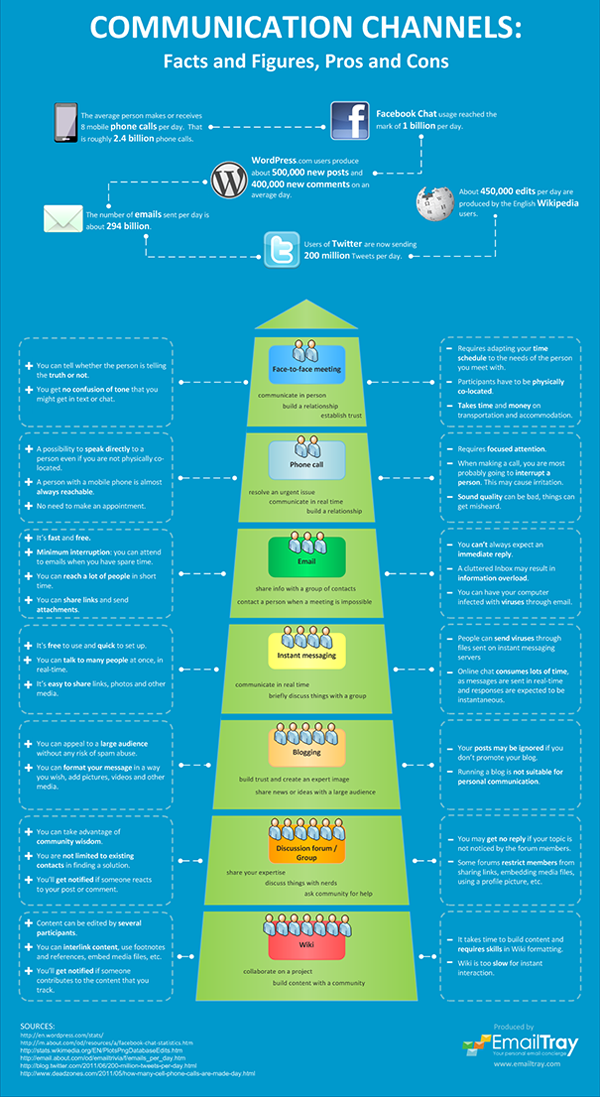
This infograph shows the communication channels that people now use. It shows multiple channels and includes the positives and negatives of each channel.


This video explains five ways that social media is changing people’s brains. Since this blog focuses on how social media is changing people’s brains and interactions, this video helps to further explain that concept.


References:


AsapScience. (2014). 5 Crazy Ways Social Media is Changing Your Brain Right Now [YouTube Video]. United States.

Pimanova, J. (2012). Communication channels infographic: Facts and figures, pros and cons. EmailTray. Retrieved from http://www.emailtray.com/blog/communication-channels-infographic-facts-and-figures-pros-and-cons/

Turkle, S. (2012, March). “Connected, but alone?.” Ted Talks. Lecture conducted from Long Beach, California.